Frederik Rung By Ludvig Grundtvig – Royal Library, Copenhagen, Public Domain, https://commons.wikimedia.org/w/index.php?curid=11368660
Frederik Rung was born on 14 June 1854 in Copenhagen, Denmark. He became a renowned conductor and composer, playing a significant role in Danish music during the late 19th and early 20th centuries. The son of Henrik Rung, Frederik grew up in a musical family, with his siblings, Georg Rung and Sophie Keller, also involved in music. He began his musical training under his father and later studied at the Royal Danish Academy of Music, where he was influenced by famous composers such as J.P.E. Hartmann and Niels W. Gade.
At just 12 years old, Rung made his public debut and quickly became a valued musician at the Royal Danish Theatre. He progressed through various roles, becoming the chief conductor of the Royal Danish Orchestra in 1908. As a composer, Rung created a diverse range of works, including operas, ballets, and choral pieces. He was honoured as a Knight of the Order of the Dannebrog for his contributions to culture. Frederik Rung passed away on 22 January 1914, leaving behind a rich musical legacy.
Benny Goodman By Photo by Jammes J. Kriegsmann, New York – Original text : eBayfrontback), Public Domain, https://commons.wikimedia.org/w/index.php?curid=49409127
Benny Goodman, known as the “King of Swing,” was a famous American jazz clarinettist and bandleader. Born in Chicago in 1909 to Jewish immigrants from the Russian Empire, he began playing the clarinet at a young age and showed great talent. He received training at Hull House and from a renowned musician, Franz Schoepp. By his teenage years, Goodman was performing professionally and made a name for himself in the vibrant jazz scene of the 1920s.
His big break came in the mid-1930s with the “Let’s Dance” radio programme, leading to a notable performance in Los Angeles in 1935. Goodman was also significant for breaking racial barriers by hiring Black musicians. His 1938 concert at Carnegie Hall established jazz as an important music genre. Throughout his life, Goodman remained a dedicated performer and helped popularise jazz, making it accessible to millions.
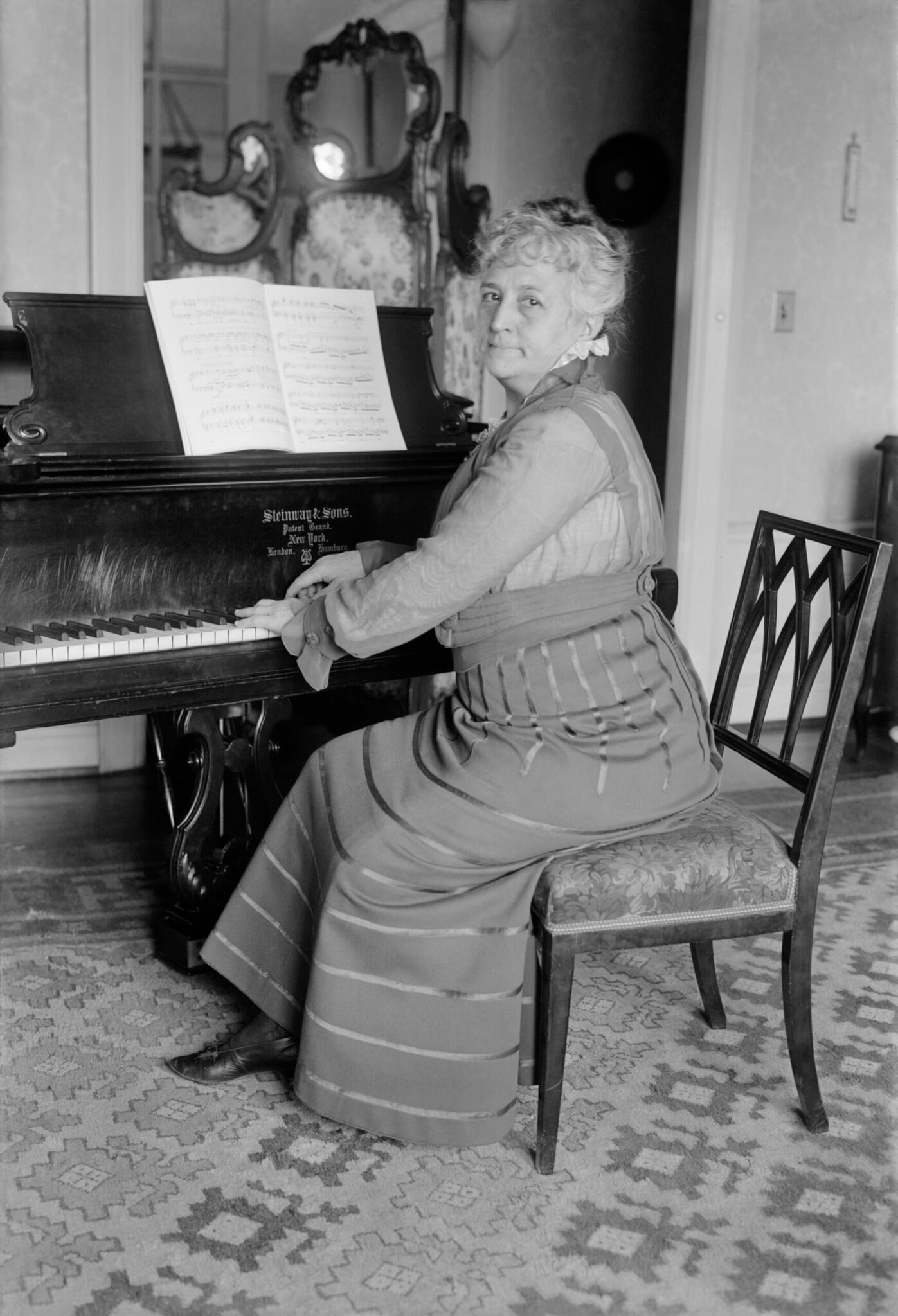
Teresa Carreño By George Grantham Bain Collection (Library of Congress)Restored by Adam Cuerden – This image is available from the United States Library of Congress’s Prints and Photographs divisionunder the digital ID ggbain.23737.This tag does not indicate the copyright status of the attached work. A normal copyright tag is still required. See Commons:Licensing., Public Domain, https://commons.wikimedia.org/w/index.php?curid=6067786
Teresa Carreño (1853–1917) was a talented Venezuelan pianist, singer, composer, and conductor. Born in Caracas to a musical family, her father was a pianist and teacher, which influenced her early talent. At the age of eight, she performed her first concert in New York after moving there due to political troubles in Venezuela. Incredibly, she even played for President Abraham Lincoln at the White House, marking the beginning of her impressive career.
Carreño studied with famous musicians and toured widely, earning admiration for her extraordinary skill and stage presence. She composed both piano and orchestral music, producing works that reflected her time’s Romantic style. Despite challenges as a female musician in a male-dominated field, she thrived, balancing family and work. Carreño’s legacy continues today, celebrating her as one of Latin America’s most important classical artists.
Richard Strauss By Max Liebermann – http://www.smb-digital.de/eMuseumPlus?service=ExternalInterface&module=collection&objectId=958865&viewType=detailView, CC0, https://commons.wikimedia.org/w/index.php?curid=613951
Richard Strauss was a renowned German composer and conductor born in 1864 in Munich. Coming from a musical family, he displayed remarkable talent as a child, writing his first compositions early on and receiving formal training in music. Strauss became famous for his tone poems, which express deep emotions and tell stories through music. Notable works, like Don Juan and Also sprach Zarathustra, gained international acclaim.
He also collaborated with librettist Hugo von Hofmannsthal, creating famous operas such as Salome and Der Rosenkavalier. These operas captivated audiences with their intricate emotional layers and beautiful melodies. Later in life, Strauss’s music grew reflective, especially in pieces like Metamorphosen. His legacy endures through his ability to blend complex ideas with powerful emotions, making him a significant figure in 20th-century classical music.
Mark-Anthony Turnage By CTV Santa Cruz County – Cabrillo Festival of Contemporary Music – Meet the Composers 2014, CC BY 3.0, https://commons.wikimedia.org/w/index.php?curid=124575622
Mark-Anthony Turnage, born on 10 June 1960, is a celebrated British composer known for blending classical music with jazz and modern culture. He grew up in Corringham, Essex, and studied at the Royal College of Music. His influential teachers included Oliver Knussen and the prominent American composer Gunther Schuller.
Turnage gained fame with his opera, Greek, in 1988, which examines the Oedipus myth through powerful music and social themes. He has since created other notable operas like The Silver Tassie and Anna Nicole, each receiving critical acclaim for their engaging styles. In addition to operas, he has written orchestral works, including Blood on the Floor, which incorporates jazz elements.
Turnage’s compositions often reflect personal experiences and societal issues while maintaining emotional depth. His work continues to excite audiences, making him one of Britain’s most important contemporary composers.
Cole Porter By unattributed, see link – http://lcweb2.loc.gov/diglib/ihas/loc.natlib.scdb.200033557/default.html, Public Domain, https://commons.wikimedia.org/w/index.php?curid=4975209
Cole Porter was an American composer and songwriter, born on June 9, 1891, in Peru, Indiana. He was known for his witty lyrics and catchy melodies, which made him a celebrated figure in 20th-century music. Despite his grandfather’s wishes for him to study law, Porter chose to pursue music, studying composition in Paris after starting at Harvard Law School.
His big break came in the late 1920s with the musical Paris, featuring the famous song “Let’s Do It, Let’s Fall in Love.” Throughout the 1930s and 1940s, he created Broadway hits like Anything Goes and Kiss Me, Kate, demonstrating his talent for clever rhymes and engaging storytelling.
Porter faced a serious horse-riding accident in 1937 that led to the amputation of a leg, but he continued to create music. He had a unique relationship with socialite Linda Lee Thomas, remaining married despite being gay. Cole Porter passed away in 1964, yet his legacy lives on through his timeless songs.
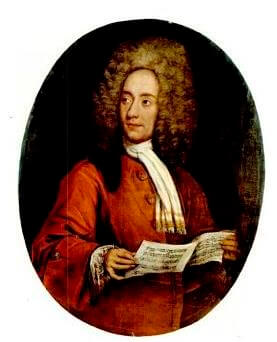
Tomaso Albinoni By anonymous – Unknown source, Public Domain, https://commons.wikimedia.org/w/index.php?curid=61401
Tomaso Albinoni was an Italian composer born on 8 June 1671 in Venice. He is best known for his beautiful instrumental music, especially his concertos and sonatas. Albinoni came from a wealthy family, which allowed him to compose music freely without financial worries. Although he claimed to be a dilettante, his skills were evident as he published nine collections of instrumental works, featuring violin, oboe, and strings. His music was loved across Europe, and even famous composer Johann Sebastian Bach admired his themes. Albinoni played a key role in developing the solo concerto and trio sonata, creating some of the first concertos for the oboe. While many of his operas are lost, his instrumental music remains popular. The piece most commonly associated with his name today, the Adagio in G minor, is believed to have been assembled by 20th-century musicologist Remo Giazotto based on a fragment of a manuscript attributed to Albinoni. Albinoni passed away on 17 January 1751, but his graceful melodies still enchant listeners today.
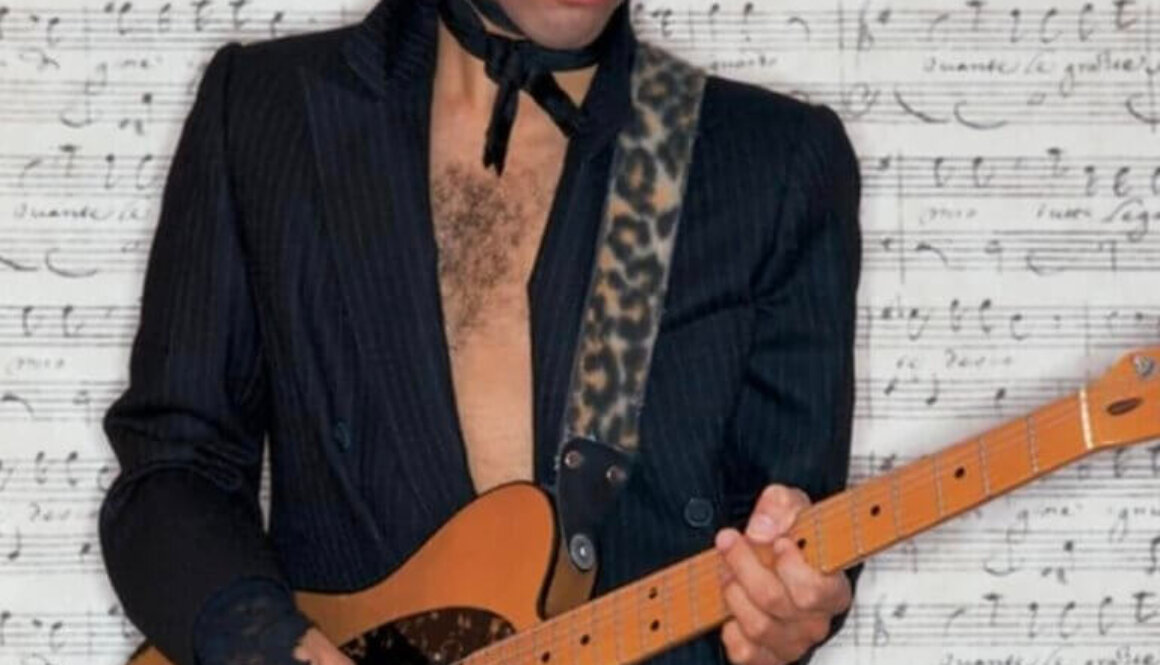
Prince By Allen Beaulieu; Distributed by Warner Bros. Records. – Worthpoint, archive, Hi-ResColor: [1], Public Domain, https://commons.wikimedia.org/w/index.php?curid=162884167
Prince Rogers Nelson, known simply as Prince, was an American singer, songwriter, and musician born on June 7, 1958. He is celebrated for his innovative music and flamboyant performances. Growing up in a musical family in Minneapolis, he displayed remarkable talent from a young age. His first album, For You, was released in 1978, but he gained fame with his albums Dirty Mind and 1999. The 1984 soundtrack album for Purple Rain made him a superstar, featuring iconic songs like “When Doves Cry.”
Throughout the 1980s and 1990s, Prince released multiple albums each year, often using different names. He was known for his unique blend of funk, rock, and pop, and won numerous awards, including seven Grammys. His battle for artists’ rights marked him as a pioneer in the music industry. Prince passed away in 2016, but his influence on music continues to inspire artists today.
A song book cover By Unknown author – https://auction.ru/offer/korobejniki_sbornik_russkikh_pesen_i_romansov_redkaja-i22696731349987.html#1, Public Domain, https://commons.wikimedia.org/w/index.php?curid=90172827
“Korobeiniki” is a 19th-century Russian folk song based on a poem by Nikolay Nekrasov. It tells the story of a travelling merchant (korobeinik) who tries to win the heart of a young girl by offering her his wares. The song captures their playful exchange as they bargain, symbolising the courtship process. Over time, “Korobeiniki” became a cherished part of Russian folk traditions.
The melody is lively and speeds up, making it a favourite for dance performances. Outside Russia, it gained global fame as the theme music for the Tetris video game, first released on Nintendo in 1989. This connection helped make “Korobeiniki” one of the most recognisable folk melodies in the world, and it has been performed in various styles, from orchestral to electronic, showcasing its lasting influence.
Carl Maria von Weber
c. 18 November 1786 – 5 June 1826
Piano Concerto No.1 in C-major
Op.11, J 98
Carl Maria von Weber By Caroline Bardua – 1. umnofil.ru2. GalleriX, Public Domain, https://commons.wikimedia.org/w/index.php?curid=22630453
Carl Maria von Weber was a German composer, conductor, pianist, and critic, born in 1786. He is best known for his important role in creating German Romantic opera. Coming from a musical family, he was trained by notable teachers, such as Michael Haydn. Weber’s music combined German folk traditions with dramatic orchestration, helping to establish a unique national opera tradition.
His most famous work, Der Freischütz, features supernatural themes and folk melodies. This opera’s overture is still one of his most performed pieces today. Later, he composed operas like Euryanthe and Oberon, which continued to influence future composers, including Wagner.
In addition to opera, Weber wrote concertos and chamber music. His Clarinet Concertos are essential pieces for clarinet players, highlighting his talent for writing for woodwinds. As a conductor, he valued precision and emotion in orchestral performances, while also contributing to music criticism and theory, promoting a distinctly German operatic style.