
Modest Mussorgsky – Night On Bald Mountain
Modest Mussorgsky 21 March [O.S. * 9 March] 1839 – 28 March [O.S. 16 March] 1881
Night On Bald Mountain

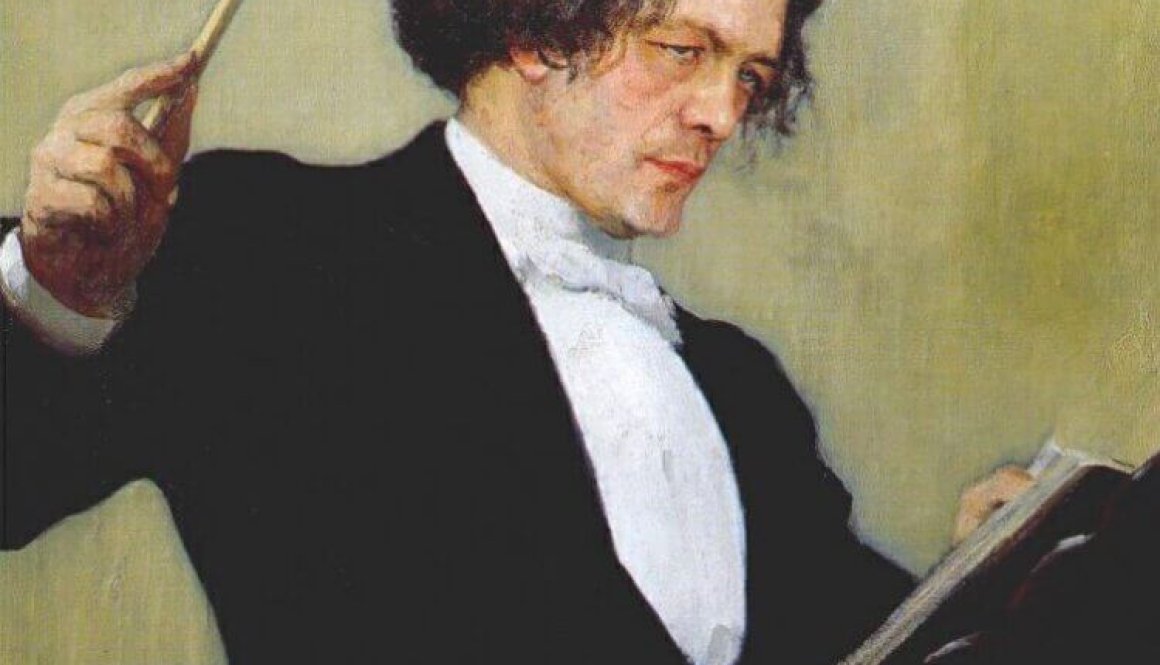
By Self-scanned, Public Domain, https://commons.wikimedia.org/w/index.php?curid=4050848
Night on Bald Mountain (Russian: Ночь на лысой горе, romanized: Noch′ na lysoy gore), also known as Night on the Bare Mountain, is a series of compositions by Modest Mussorgsky (1839–1881). Inspired by Russian literary works and legend, Mussorgsky composed a “musical picture”, St. John’s Eve on Bald Mountain (Russian: Иванова ночь на лысой горе, romanized: Ivanova noch′ na lysoy gore) on the theme of a Witches’ Sabbath occurring at Bald Mountain on St. John’s Eve, which he completed on that very night, 23 June 1867. Together with Nikolai Rimsky-Korsakov’s Sadko (1867), it is one of the first tone poems by a Russian composer.
Although Mussorgsky was proud of his youthful effort, his mentor, Mily Balakirev, refused to perform it. To salvage what he considered worthy material, Mussorgsky attempted to insert his Bald Mountain music, recast for vocal soloists, chorus, and orchestra, into two subsequent projects—the collaborative opera-ballet Mlada (1872), and the opera The Fair at Sorochyntsi (1880). However, Night on Bald Mountain was never performed in any form during Mussorgsky’s lifetime.
In 1886, five years after Mussorgsky’s death, Rimsky-Korsakov published an arrangement of the work, described as a “fantasy for orchestra.” Some musical scholars consider this version to be an original composition of Rimsky-Korsakov, albeit one based on Mussorgsky’s last version of the music, for The Fair at Sorochyntsi.
It is through Rimsky-Korsakov’s version that Night on Bald Mountain achieved lasting fame. Premiering in Saint Petersburg in 1886, the work became a concert favourite. Half a century later, the work obtained perhaps its greatest exposure through the Walt Disney animated film Fantasia (1940), featuring an arrangement by Leopold Stokowski, based on Rimsky-Korsakov’s version. Mussorgsky’s tone poem was not published in its original form until 1968. It has started to gain exposure and become familiar to modern audiences.
Modest Petrovich Mussorgsky was a Russian composer from the Romantic era and a member of “The Five”, a group that aimed to create a uniquely Russian style of classical music. He was known for rejecting Western musical conventions in favour of realism, Russian speech rhythms, and themes from history and folklore. His most famous works include the opera Boris Godunov, the orchestral piece Night on Bald Mountain, and the piano suite Pictures at an Exhibition. Many of his compositions were not widely performed during his lifetime and were often revised by other composers like Nikolai Rimsky-Korsakov. Mussorgsky was born into a wealthy family in the Pskov region and began piano lessons as a child. He entered military training but left to pursue music. In Saint Petersburg, he met influential figures who shaped his artistic direction. Mussorgsky aimed to reflect life “as it is truly lived”, particularly through natural vocal writing. His later life was marked by instability and alcoholism, yet he produced powerful works. He died in 1881 at 42 and is remembered for his originality and bold musical language.
*Old Style (O.S.) and New Style (N.S.) indicate dating systems before and after a calendar change, respectively. Usually, they refer to the change from the Julian calendar to the Gregorian calendar as enacted in various European countries between 1582 and 1923.